Learning Outcomes:
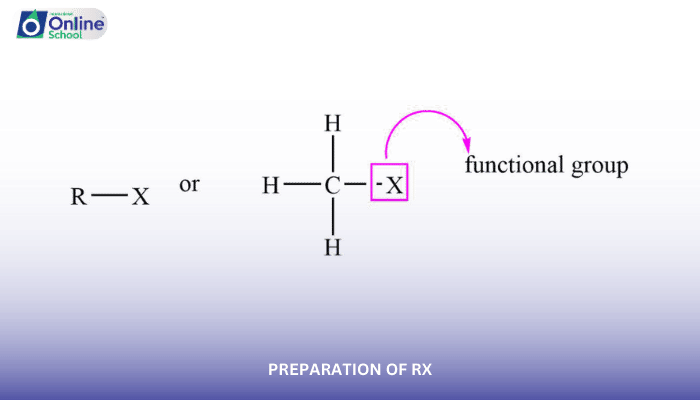
i. Comprehend the various methods for synthesizing alkyl halides (RX), a class of organic compounds containing a halogen atom (-X) attached to an alkyl group (R-).
ii. Understand the mechanisms involved in the preparation of alkyl halides from alcohols using different reagents, including hydrogen halides (HX), thionyl chloride (SOCl2), and phosphorus trihalides (PX3).
iii. Explain the concept of radical halogenation of alkanes and its application in the preparation of alkyl halides.
iv. Identify the factors that influence the reactivity of alcohols and the choice of reagent for alkyl halide synthesis.
v. Appreciate the importance of alkyl halide preparation in organic synthesis due to their versatility as intermediates.
Introduction:
Alkyl halides, also known as haloalkanes, are organic compounds in which a halogen atom (-X, such as chlorine, bromine, iodine, or fluorine) is attached to an alkyl group (R-). They are commonly used as reagents in organic synthesis due to their high reactivity in nucleophilic substitution reactions.
i. Preparation of Alkyl Halides from Alcohols:
Reaction with Hydrogen Halides (HX):
- Alcohols react with hydrogen halides (HX, such as HCl, HBr, or HI) to form alkyl halides.
- The reaction proceeds through an SN1 or SN2 mechanism, depending on the structure of the alcohol and the reaction conditions.
- Primary alcohols favor SN2 reactions, while secondary and tertiary alcohols favor SN1 reactions.
Reaction with Thionyl Chloride (SOCl2):
- Thionyl chloride (SOCl2) is a versatile reagent for converting alcohols to alkyl halides.
- The reaction proceeds through a nucleophilic substitution mechanism, where SOCl2 first reacts with the alcohol to form an intermediate, followed by halogenation of the alcohol to the alkyl halide.
Reaction with Phosphorus Trihalides (PX3):
- Phosphorus trihalides (PX3, such as PCl3 or PBr3) are effective reagents for converting alcohols to alkyl halides.
- The reaction proceeds through a nucleophilic substitution mechanism, similar to the reaction with thionyl chloride.
ii. Radical Halogenation of Alkanes:
Chlorination and Bromination:
- Alkanes can undergo chlorination or bromination in the presence of free radical initiators, such as light or peroxides.
- The reaction proceeds through a radical chain mechanism, where the initiator generates halogen radicals that attack the alkane, forming alkyl radicals.
- Alkyl radicals then react with halogen molecules to form alkyl halides.
iii. Factors Influencing Reactivity:
Structure of the Alcohol:
- Primary alcohols are generally more reactive than secondary alcohols, and secondary alcohols are more reactive than tertiary alcohols.
Nature of the Halogenating Agent:
- HF is the weakest halogenating agent, followed by HCl, HBr, and HI.
- Stronger halogenating agents favor SN1 reactions, while weaker halogenating agents favor SN2 reactions.
Alkyl halides can be synthesized from alcohols using various methods, including reaction with hydrogen halides, thionyl chloride, and phosphorus trihalides. The choice of reagent and reaction conditions depends on the structure of the alcohol and the desired alkyl halide. Radical halogenation of alkanes provides an alternative route to alkyl halides, particularly for simple alkyl chains. Understanding the preparation and reactivity of alkyl halides is essential for their effective utilization in organic synthesis.
